
AI sales forecasting tools promise a sharper number, and most of them deliver exactly that. This guide covers what these tools actually model, why forecast accuracy still lags adoption, and the evaluation questions that matter more than the vendor’s demo.
Most sales organizations have already said yes to AI forecasting tools, and adoption is no longer an open question. What’s still unresolved is whether sales leaders trust the numbers they’re looking at during a quarter-end review. Reps’ activity, deal stages, and call data all feed into a model built to predict the close, and the forecast keeps missing in the same direction it always did.
That’s not really a modeling failure. It’s a data problem the model can’t fix by itself, because the model only knows what reps enter, and reps update a pipeline the way most people update anything they’d rather not look at too closely. An AI forecasting tool makes the math sharper. It doesn’t make the underlying number more honest, and that distinction is exactly what sales leaders need to understand before they buy, deploy, or lean harder on one.
Key takeaways
- AI sales forecasting tools live in three overlapping layers: native CRM forecasting, deal-level platforms, and revenue intelligence. They stack rather than compete, and skipping straight to the most sophisticated layer without solid stage hygiene underneath usually just produces a more confident wrong number.
- Forecast accuracy hasn’t kept pace with AI adoption because every model trains on the same underlying inputs. The tool can’t tell honest data from optimistic data.
- The evaluation questions that matter aren’t in the demo. Ask what data actually feeds the model, how it handles uncertainty, and whether it fits the size of the problem you have now.
- Pair AI forecasting with real-time visibility, coaching, and recognition. Without that, you’re producing a sharper wrong number, faster.
- Run the AI forecast in parallel with the manual roll-up for at least a quarter. Trust in the number that drives hiring and quota decisions doesn’t transfer because a vendor says the model is accurate.
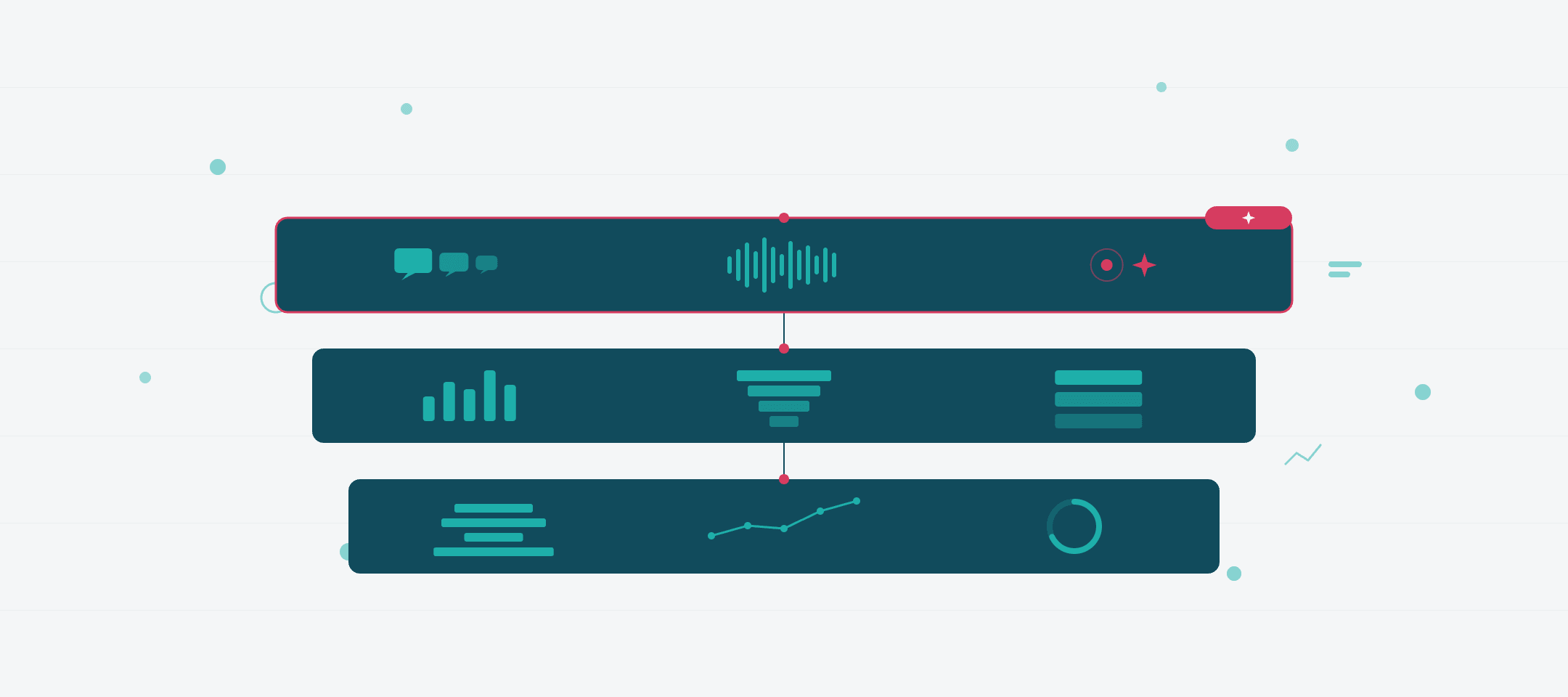
AI sales forecasting sits on three overlapping layers.
Native CRM forecasting, built into platforms like Salesforce Einstein or HubSpot, scores each open opportunity against historical win patterns and rolls those scores into a category-level number. It’s the fastest to deploy because it runs on data you already have, and it’s the right starting point for smaller teams with clean CRM hygiene.
Deal-level forecasting platforms go a layer deeper, ingesting activity signals, stage changes, and commit categories to produce multi-dimensional forecasts, such as best case, commit, and upside, that account for deal risk rather than treating every open opportunity the same.
Revenue intelligence platforms add a third input: conversation data. They analyze calls, emails, and meetings to flag deal health signals a CRM field never captures, like a champion going quiet or a technical stakeholder raising a new objection.
None of these categories compete with each other so much as stack. A mid-market SaaS team running 60 to 80 reps across SDR and AE motions typically starts with native CRM forecasting, adds a deal-level platform once pipeline volume outgrows what a manager can eyeball in a Monday review, and layers in conversation intelligence only after the first two are producing forecasts leadership actually trusts. Skipping straight to the most sophisticated layer without solid stage hygiene underneath it usually just produces a more confident wrong number.
Why forecast accuracy hasn’t caught up with adoption
AI adoption in sales forecasting is no longer the exception. In Salesforce’s most recent State of Sales survey of more than 4,000 sales professionals, 87 percent of organizations already use some form of AI for prospecting, forecasting, lead scoring, or drafting outreach. What hasn’t moved at the same pace is the number those tools produce. Gartner’s research on AI in sales found that only 7 percent of teams hit 90 percent forecast accuracy or better, with the median team landing between 70 and 79 percent, and 69 percent of sales operations leaders say forecasting has gotten harder over the past three years, not easier.

That gap makes sense once you look at what the model is actually reading. Every AI forecasting tool, regardless of category, trains on the same underlying inputs: CRM fields, activity logs, and deal-stage history. If a rep pushes a close date because the deal genuinely slipped, the model learns something real. If a rep pushes it because updating the true stage means an awkward pipeline review, the model learns the same lesson either way, because it has no mechanism to tell honest data from optimistic data. The forecast doesn’t get more accurate because the tool got smarter. It gets more accurate when the behavior generating the underlying data gets more consistent, and that’s a management problem, not a modeling one.
What to evaluate before you buy or expand
Sales leaders evaluating an AI forecasting tool tend to focus first on the demo: how clean the dashboard looks, how confidently the AI explains its numbers. The more useful questions sit one level down.
What data actually feeds the model
Ask whether the forecast draws only from CRM fields a rep manually updates, or whether it also pulls activity and engagement signals a rep can’t easily shape, like email opens, meeting attendance, or call recordings. A tool reading only manually entered fields inherits every incentive problem your pipeline reviews already have.
How the tool handles uncertainty
A forecast that outputs a single number is less useful than one that shows a range and the confidence behind it. Multi-dimensional roll-ups, covering best case, commit, upside, and full pipeline, tell a sales leader where the real risk sits, rather than collapsing everything into one figure that looks precise and isn’t.
Whether it fits the size of the problem you actually have
A five-person team with a short sales cycle doesn’t need a revenue intelligence platform built for thousand-person enterprise orgs, and a 500-rep organization can’t run forecasting off a tool built for simplicity. Match the tool to the pipeline volume and deal complexity you have now, not the org you might be in three years.
It’s also worth knowing where the market actually sits, because vendor marketing tends to describe forecasting AI as fully mainstream when the underlying adoption data tells a more mixed story. McKinsey’s research on generative AI in B2B sales found that only 19 percent of B2B decision-makers have fully implemented gen AI use cases, with another 23 percent in the process of rolling them out. Forecasting-specific AI is further along than general-purpose gen AI, but the broader pattern holds: most sales organizations are earlier in this shift than the vendor conversations suggest, and there’s no penalty for taking the evaluation seriously instead of rushing to keep pace with a narrative.
Closing the gap a model can’t close

An accurate forecast still depends on reps doing the unglamorous work of keeping deal stages honest, logging activity consistently, and flagging risk the moment they see it, not at the end-of-month review. That’s a visibility and coaching problem, and it sits outside what any forecasting model touches. Teams that pair AI forecasting with real-time visibility into rep activity give both reps and managers a reason to keep the underlying data current: reps see their own numbers continuously rather than once a week, and managers get the time back to coach before a deal slips instead of explaining why it already did.
Predictive sales analytics pulls the same behavioral signal earlier in the funnel, surfacing which activity patterns predict outcomes before a deal even reaches the stage where a forecasting tool would flag it. Combined with AI in sales pipeline management to catch deal-level risk, and a sales dashboard that puts the data in front of reps continuously rather than in a report a manager pulls once a week, the forecast becomes a byproduct of good pipeline hygiene rather than a separate exercise bolted onto quarter-end.
Recognition closes the loop. When a rep updates a deal stage accurately or flags risk early, and that behavior gets acknowledged rather than disappearing into a CRM field nobody looks at, the behavior repeats. This is where a lot of forecasting rollouts quietly stall. Leadership buys the tool, trains the team on it once, and then wonders six months later why forecast accuracy still sits where it did before. A sales performance management system that ties visibility, coaching, and recognition into the daily rhythm gives reps a reason to keep the inputs honest beyond a compliance mandate from RevOps.
For a multi-location insurance agency or a regional bank running forecast roll-ups across a dozen branch teams, the failure mode looks slightly different: the model itself is fine, but nobody at the branch level has real-time visibility into their own numbers, so stage updates lag by days instead of hours. The fix isn’t a better algorithm. It’s putting the same data the AI model needs in front of the people generating it, continuously, so the roll-up reflects what’s actually happening rather than what got updated during Friday’s cleanup.
Rolling it out without losing your manager's trust
AI forecasting works best when introduced alongside the process it’s meant to improve, not as a replacement on day one. Run the AI-generated forecast in parallel with the existing manual roll-up for at least one full quarter. That overlap does two things: it gives managers time to calibrate where the model over-predicts or under-predicts for their specific team, and it gives reps time to trust that the tool is reading their real activity rather than penalizing an honest update. Teams that skip the parallel period and switch cold tend to see managers quietly revert to their own spreadsheet within a month, because trust in a number that affects hiring and quota decisions doesn’t transfer just because a vendor says the model is accurate.
The teams that get the most out of AI forecasting treat the rollout as a change in daily behavior, not a change in software. Every AI insight, a flagged risk, a slipping commit category, a stalled deal, needs a clear human response built into the workflow: a coaching conversation, a manager check-in, a rep correcting the stage before the model has to guess. Teams that treat forecast accuracy as one lever inside a broader effort to improve sales performance, rather than a standalone fix, tend to see the gap close faster.
The model sharpens the number. Your team makes it honest.
AI sales forecasting tools are good at exactly what they’re built for: turning deal-stage and activity data into a sharper, faster number than a spreadsheet ever produced. What they can’t do on their own is make the underlying data more honest, and that’s the piece that actually determines whether the forecast is worth trusting. Pair the model with the visibility, coaching, and recognition that keep reps updating their pipeline in real time instead of during Friday cleanup, and the forecast stops being a guess dressed up in machine learning. It becomes a genuinely useful read on where the quarter is actually headed.
If forecast accuracy keeps lagging despite the AI investment, the fix probably isn’t a better model. SalesScreen’s visibility, coaching, and recognition tools are built for exactly that layer, closing the gap between what the AI predicts and what the team actually does about it.
Frequently asked questions
What’s the difference between AI sales forecasting and predictive sales analytics?
AI sales forecasting predicts revenue outcomes from deal-stage and CRM data, essentially projecting the close. Predictive sales analytics operates further upstream, reading activity and behavioral patterns, such as calls, meetings, and pipeline creation, to flag which reps or deals are trending toward a problem before that problem shows up as a forecast miss. The two work well together: forecasting tells you the number, predictive analytics tells you why the number is moving.
Can AI forecasting replace the manual pipeline review?
Not entirely, and most sales leaders shouldn’t want it to. AI forecasting removes the manual math and surfaces risk earlier, but the pipeline review still does something the model can’t: it’s where a manager asks a rep the uncomfortable question about a deal the data hasn’t caught up to yet. Teams that get the best results treat the AI forecast as the starting point for that conversation, not a substitute for having it.
How accurate should sales leaders expect an AI forecast to be?
Realistically, expect improvement, not perfection. Gartner’s research on AI in sales found the median sales team sits between 70 and 79 percent forecast accuracy, with only a small fraction hitting 90 percent or better, even accounting for AI adoption. Accuracy depends less on the sophistication of the model than on how consistently reps keep the underlying CRM and activity data current.
Does a small sales team need a dedicated AI forecasting platform?
Usually not right away. Teams under roughly 20 reps with clean CRM hygiene often get enough value from native forecasting built into their existing CRM, like Salesforce Einstein or HubSpot’s forecasting tools. Dedicated deal-level or revenue intelligence platforms tend to earn their cost once pipeline volume outgrows what a manager can review by hand each week.
Why does forecast accuracy stay flat even after adopting an AI tool?
The most common reason is that the tool is trained on the same inconsistent data the manual forecast always relied on. AI can weight signals more precisely than a person, but it can’t tell an honest stage update from an optimistic one. If rep behavior around logging activity and updating stages doesn’t change, the model just produces a more confident version of the same inaccurate number.
How long does it take to trust an AI-generated forecast over a manual one?
Most sales organizations run the AI forecast in parallel with the existing manual process for at least a full quarter before making it the primary number. That period lets managers see where the model consistently over-calls or under-calls for their specific team and lets reps confirm the tool is reading their actual activity rather than penalizing routine pipeline movement.
