
A sales operations team isn’t overhead. It’s the layer that keeps your pipeline clean, your forecast honest, and your reps focused on selling. This guide covers the models, roles, and hiring sequence that hold up as a B2B SaaS team scales.
A few reps and a shared spreadsheet can run a small SaaS sales team just fine. Then you add headcount, more inbound, more handoffs, and a longer list of deals moving at once. The same setup that felt nimble starts to creak. Pipeline stages mean different things to different people, follow-ups slip, and the forecast changes shape every Monday. The work is still getting done. It just stops being predictable.
That unpredictability is the signal you need a real sales operations team structure, not just better habits. Sales Ops is the layer that turns selling from a set of individual instincts into a repeatable, measurable motion. This guide walks through what a sales operations team owns, the three structures most B2B SaaS companies use, the roles that fill them, when to make your first hire, and the part most articles skip: making sure the structure you build actually changes what reps do each day.
TL;DR
- Sales Ops exists to make selling repeatable. It owns clean CRM data, clear pipeline rules, trustworthy reporting, and a forecast leaders can act on.
- Three structures cover most B2B SaaS teams: the Island (one owner end to end), the Assembly Line (specialists by function), and the Pod (ops embedded by segment).
- Match the model to your stage. Start centralized, add specialists as deal volume grows, then embed pods when different segments sell in different ways.
- Most teams need a dedicated Sales Ops hire when CRM hygiene slips, forecasts wobble, and admin work steals selling time from reps.
- Structure produces clean data. Whether reps act on that data depends on whether they can see it in real time and feel motivated by it.
What a sales operations team actually does
Sales Operations is the function that removes friction from selling so reps can spend more time in front of buyers and managers can make decisions from data they trust. It doesn’t replace selling. It builds the rails that selling runs on.
In a B2B SaaS company, a sales operations team typically owns a few clear areas. It sets the sales process and pipeline rules: stages, exit criteria, deal hygiene, and how aging deals get flagged. It owns the CRM, from fields and automation to integrations and data quality. It builds the reporting layer, including dashboards, funnel metrics, and conversion tracking. It supports forecasting through pipeline coverage and risk review. And it handles planning work like territories, quotas, capacity, and often commissions.
Reporting is where Sales Ops earns trust or loses it. Salesforce notes that the real challenge for many sales leaders isn’t a shortage of data but too much of it, with no clear focus, which makes confident decisions harder rather than easier. A good Sales Ops team fixes that by deciding which numbers matter and building reporting around them. If you’re still mapping which metrics deserve a dashboard, our breakdown of sales KPIs and the wider set of sales performance metrics is a useful starting point.
Sales Ops vs. RevOps: where the line sits
These two terms get used as if they mean the same thing, and the difference matters when you’re deciding how to organize.
Sales Ops focuses on how the sales team runs day to day. It owns the sales process, CRM setup, pipeline hygiene, reporting, forecasting support, and planning tasks like territories and quotas. Its job is to reduce admin work, remove process confusion, and hand sales leaders clean data to manage performance.
RevOps takes a wider view. It aligns operations across the full revenue engine, usually Marketing, Sales, and Customer Success, and connects the customer relationship from first touch to renewal. It standardizes shared definitions like MQL and SQL, fixes handoffs between teams, and owns lifecycle reporting end to end.
Sales Ops is enough when your funnel is relatively simple, your main problems are CRM setup and forecasting, and Marketing and CS don’t yet need deep operational alignment. You move toward RevOps when leads pass through several handoffs (Marketing to SDR to AE to CS), when reporting needs to cover retention and expansion, and when definitions and data drift between teams. The pull toward that alignment isn’t hypothetical: in HubSpot’s 2025 State of Sales report, better alignment was named by more than a quarter of sales leaders as a top goal for the year. A mid-region bank running 60 to 80 users across Customer Care, Advisors, and core Sales often hits this point first in its reporting, because branch performance only makes sense when the full customer relationship is visible in one place. Better forecasting is usually the prize either way, and predictive sales analytics is where clean Sales Ops data starts to pay off, turning lagging results into earlier signals managers can act on.
The three B2B SaaS sales operations team structures
Most teams land on one of three models. The right one depends on how you sell and how complex your handoffs are.
The Island Model
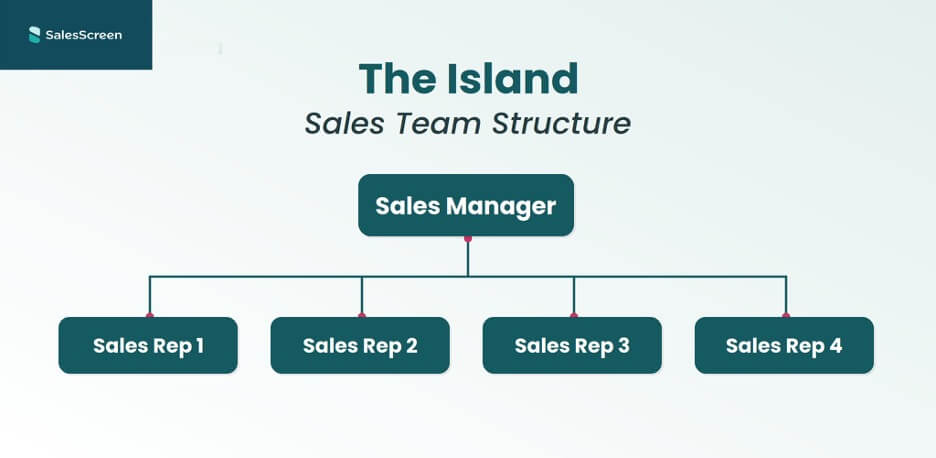
The Island is a centralized setup where one person, or a small group, owns most of operations end to end: CRM, reporting, process rules, lead routing, and forecasting support. It’s where almost every SaaS company starts.
Its strength is speed and clarity. One owner controls the system and the standards, so decisions are fast and there’s no ambiguity about who owns what. The trade-off is capacity. As the team grows, a single owner becomes a bottleneck, and the role gets stretched thin across too many areas.
The Assembly Line Model
.jpg)
In the Assembly Line, different people own different areas: CRM and systems, analytics and reporting, forecasting, compensation, and deal desk support. Each specialist works their own lane and builds deep expertise in it.
This model improves both speed and quality because specialists don’t context-switch across every problem. It fits SaaS companies with higher deal volume, multiple teams, and more complex planning. The watch-out is coordination. Segmented roles can drift apart, so the handoffs between lanes need to be defined as carefully as the lanes themselves.
The Pod Model
.jpg)
The Pod embeds ops support inside specific sales segments or regions: SMB, Mid-Market, Enterprise, or a geography. Each pod gets dedicated ops help that understands its pipeline, targets, and daily workflow.
Pods increase responsiveness because the ops person already knows the segment’s motion and reporting needs. This works well when segments genuinely sell in different ways and need different dashboards and rules. It’s also where unit economics get interesting, because you can compare return across pods and regions. Reading sales efficiency at the team level, rather than only company-wide, tells you which pods return more per dollar, which is exactly the input you want when deciding where to add headcount.
Quick Comparison
A simple way to choose: start on the Island, move to the Assembly Line as volume and planning complexity grow, then introduce Pods once segments diverge enough to justify dedicated support. Most scaling SaaS orgs pass through all three rather than picking one forever.
The core sales operations roles
Inside whichever model you pick, a handful of roles do the work. You won’t need all of them at once, and the order you add them matters more than the titles.
The Sales Operations Manager is the anchor hire. This person applies real sales knowledge to build strategy, shape territories, and run the forecast cadence. The Sales Operations Analyst organizes and evaluates data, watches trends, and finds places to automate. The Systems or CRM Administrator keeps the tech stack healthy, owns integrations, and acts as the go-to for anything that touches the CRM. As deals get more complex, a Deal Desk function steps in to support pricing, approvals, and non-standard contracts. And as the team matures, a Sales Enablement owner takes over onboarding, training design, and the playbooks that shorten ramp time.
Smaller teams fold several of these into one or two people. Larger ones add a Senior Manager or a Sales Operations Director on top. The point is coverage, not headcount: every responsibility above needs an owner, even if that owner wears three hats this quarter.
When to hire your first Sales Ops role
The first dedicated Sales Ops hire usually comes later than it should. The signals are consistent across SaaS teams. CRM data gets unreliable, so reporting can no longer be trusted at face value. Forecasts swing week to week with no clear reason. Lead routing becomes inconsistent, and good leads sit untouched. And reps spend a growing share of their week on admin instead of selling.
That last signal is the most expensive one. The honest pattern across the research is that reps spend well under half their week selling. Salesforce’s 2026 sales statistics put a number on it: around 60 percent of a rep’s time goes to non-selling work like data entry, internal meetings, and tool-switching. A mid-market SaaS team of 30 to 60 reps running manual SPIFFs in a spreadsheet feels this acutely, because the person building and tracking those incentives by hand is usually a frontline manager who should be coaching instead. When you see admin quietly eating selling time, you’re past due for an owner whose job is to give it back. The downstream effect shows up directly in sales rep productivity, which improves once someone owns the systems and habits that protect a rep’s selling hours.
Structure is only half the job
A well-built sales operations team gives you clean data, clear dashboards, and a reliable forecast. None of that changes a single deal on its own. The structure is the input. What reps and managers do with the output is what moves revenue.
This is the gap that quietly undermines good Sales Ops work. Your reps can see they’re behind quota, but a number on a dashboard doesn’t tell them what to change or give them a reason to change it today. Your managers have pipeline reports, yet reports don’t automatically become better coaching conversations. The data is necessary. It isn’t sufficient.
Engagement is what closes that gap, and it’s under real pressure right now. Gallup’s State of the Global Workplace found that only about one in five employees worldwide were engaged in 2025, with manager engagement falling fastest of all, even though managers are the single biggest driver of how their teams feel about the work. For a sales org, that isn’t a soft culture issue. It’s the difference between a clean dashboard that gets ignored and one that sets the tone for the day.
This is where a performance layer sits on top of the structure Sales Ops builds. SalesScreen takes the clean activity and CRM data your ops team works hard to maintain and makes it visible and motivating on the floor: live progress toward targets, recognition the moment a milestone lands, and contests that run without a manager building them by hand in a spreadsheet. Scout AI works on the same data at the people level, consolidating activity signals, CRM progression, and engagement into a feed that tells a manager which rep is trending the wrong way and which coaching conversation to have first. The result is that good Sales Ops data stops living in a report and starts shaping behavior. If motivation is the lever you’re missing, our guide on how to motivate a sales team goes deeper on the practical side of making visibility actually land.
The tools a sales operations team needs
.jpg)
A capable Sales Ops team runs on a connected stack, not a pile of disconnected apps. The core pieces are consistent: a CRM as the system of record, a sales engagement tool for outreach at scale, a scheduling tool to reduce friction on booking, lead capture for inbound, and a reporting or BI layer for dashboards and forecasting. Automation ties them together so data flows without manual entry.
One layer is easy to overlook. Once the operational stack is clean, a performance and visibility layer turns that data into daily focus and recognition for reps. Treat it as part of the stack, not an afterthought, because it’s the piece that decides whether all the clean data actually reaches the people doing the selling.
Closing thought
A sales operations team structure is a sequence, not a single decision. Start centralized, specialize as you grow, and embed pods when your segments earn it. Get the roles covered before you worry about titles, and hire your first owner the moment admin starts stealing selling time.
Then remember the part that finishes the job. Clean data is the foundation, not the outcome. The teams that pull ahead are the ones where that data reaches reps in real time and gives them a reason to act on it. If you want to see how visibility and motivation turn a solid ops foundation into steady results, take a look at how SalesScreen helps teams improve sales performance, or book a short walkthrough to see it against your own setup.
Frequently asked questions
What does a sales operations team do in B2B SaaS?
A sales operations team builds and maintains the systems behind selling: the sales process and pipeline rules, CRM setup and data quality, reporting and dashboards, forecasting support, and planning work like territories, quotas, and often commissions. The goal is to reduce admin load on reps and give leaders clean data to manage performance.
What’s the difference between Sales Ops and RevOps?
Sales Ops improves how the sales team runs day to day. RevOps aligns operations across Marketing, Sales, and Customer Success to manage the full revenue engine end to end. Many SaaS companies start with Sales Ops and fold it into RevOps as handoffs and reporting grow more complex.
When should a SaaS company hire its first Sales Ops person?
Most teams need one when deal volume rises and leaders start to struggle with CRM consistency, forecast accuracy, lead routing, and the amount of admin work landing on reps. If your forecast swings every week and reps spend more time updating records than selling, it’s time.
How do you structure Sales Ops for SMB versus enterprise?
Smaller teams usually run a lean, centralized Island model with simple automation and reporting. Larger teams add specialized roles for systems, analytics, deal desk, and compensation (the Assembly Line) or embed ops pods aligned to segments and regions (the Pod). Match the model to deal volume and how differently your segments sell.
How does Sales Ops improve forecasting?
It standardizes pipeline stages, enforces required deal fields, tracks deal health, and builds reporting that shows pipeline coverage and risk clearly. Clean, consistent inputs are what make a forecast trustworthy, and they’re also what make earlier, predictive signals possible.
What roles make up a sales operations team?
The common roles are a Sales Operations Manager, a Sales Operations Analyst, a Systems or CRM Administrator, a Deal Desk function for complex pricing and approvals, and a Sales Enablement owner for onboarding and training. Smaller teams combine several of these into one or two people.