Inconsistent Performance isn't a Discipline Problem. It's a Motivation Problem.
Most sales teams know what they need to do, but they're not consistently driven to do it. Activity spikes at month-end and drops midweek while top performers sustain steady effort and others build momentum then lose it.
The issue isn't skill or discipline. Reps clearly know what works, but the breakdown happens because people respond to different motivation triggers. When your reinforcement doesn't match how each rep is wired, effort becomes sporadic. Consistency requires personalized motivation that aligns with individual drivers, not one-size-fits-all tactics.

Outcome-Only Motivation Creates Spikes, Not Stability
Most teams rely on the same levers: base salary plus commission, one-time SPIFFs, leaderboards, and end-of-month contests. When motivation lives only at the outcome level, daily effort becomes disconnected from reward. Commission checks come too late to influence daily behavior. SPIFFs create urgency at deadline then disappear. Month-end contests spike activity then go flat.
The real problem isn't these tactics themselves, it's that they assume everyone responds to the same motivations and time horizons. People are wired differently and what drives one rep forward leaves another unmotivated.
Motivation Is Psychological and Personal
Understanding personality is useful, but what matters is how it translates into motivation. In 1996, researcher Richard Bartle identified four player types that predict how people respond to competition, recognition, and reward: Achievers, Explorers, Socializers, and Killers. The framework came from studying player behavior, and the same wiring shows up in sales teams.
Most traditional sales incentives, like leaderboards, contests, and commissions, speak directly to only two of those types. Killers and some Achievers, roughly 11% of most teams, respond well to that kind of competition and status. The other 89% are built to respond to recognition, connection, mastery, or discovery instead, so the same tactics leave them unmotivated or feeling unrecognized despite putting in the work. Matching reinforcement to how each player type is wired is what turns sporadic effort into something consistent.

Achievers
Achievers are goal-oriented and metrics-focused. They thrive on milestones, badges, and personal records. They represent roughly 10% of the workforce.


Explorers
Explorers are curious and mastery-driven. They want to learn, grow, and find the next big opportunity. Another ~10% of the workforce and their top-of-funnel work is often the least recognized.

Socializers
Socializers are people-first. Recognition, connection, and team wins drive them. They make up a massive 80% of the workforce, yet are rarely incentivized to sell the way they want to.

Killers
Killers are competitive and status-driven. They want to be the best and prove it. They're the quintessential sales rep — but they make up less than 1% of the workforce.
Reinforce Behavior. Build Momentum.
Gamification isn't about games. It's about reinforcing the behaviors that drive results. When applied correctly, it makes activity visible and progress tangible. Small, real-time wins reinforce the right actions, while different motivational drivers (competition, recognition, connection) are activated across your team at scale.
Instead of rewarding only outcomes, you reinforce the behaviors that create them. Instead of hoping reps stay engaged, you build a system that keeps them engaged. By separating activities from outcomes and reinforcing behaviors based on how individuals are motivated, small wins build momentum. That leads to more consistent execution and more predictable performance.
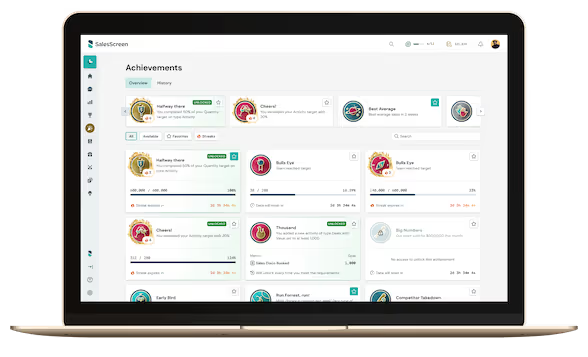
SalesScreen turns motivation into a system, not a speech.
It delivers individualized incentives and recognition that activate competitive, achievement-driven, mastery-oriented, and connection-driven reps alike. It keeps progress visible in the moment and engagement continuous rather than episodic.
Through Missions, Competitions, Achievements, Battles, and Endorsements, performance isn't just reviewed at the end of the week, it's reinforced as it happens.
When the right actions get reinforced consistently, managers stop guessing and start coaching from what's actually happening.