

Training platforms teach skills. Analytics platforms measure outcomes. This guide covers the tools that do each job well, and the layer that connects them so trained behavior actually shows up in your numbers.
Your reps completed the certification. The dashboards are current. The training platform says the team is ready, and the analytics platform says the quarter is behind. Both tools are doing exactly what they were bought to do, and the number still isn’t moving.
Here’s the uncomfortable part: the training content is probably fine, and so is the reporting. The problem is that in most sales stacks, training tools and analytics tools have never actually met. One teaches skills before the call. The other measures outcomes after the deal. Nothing in between connects what a rep learned on Tuesday to what they actually did on Thursday.
The teams that get real return from both investments aren’t buying a better platform in either category. They’re closing the gap between the two. That gap has a name, reinforcement, and it’s the lens this guide uses to sort the tools worth your budget.
Key Takeaways
- Training tools measure learning. Analytics tools measure outcomes. Neither one, on its own, tells you whether a trained skill actually showed up in a live deal, which is the gap reinforcement is built to close.
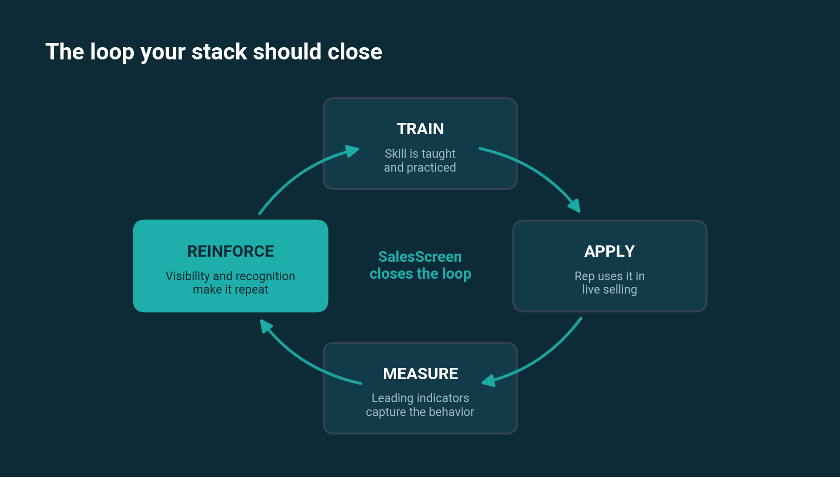
- Combining training and analytics well requires three things: shared behavioral data across both systems, measurement at the level of leading indicators, and a reinforcement loop the rep actually sees, not just the manager.
- Training decays fast without reinforcement. Skill applied in the field drops off sharply within weeks of a workshop unless something in the daily workflow asks for it again.
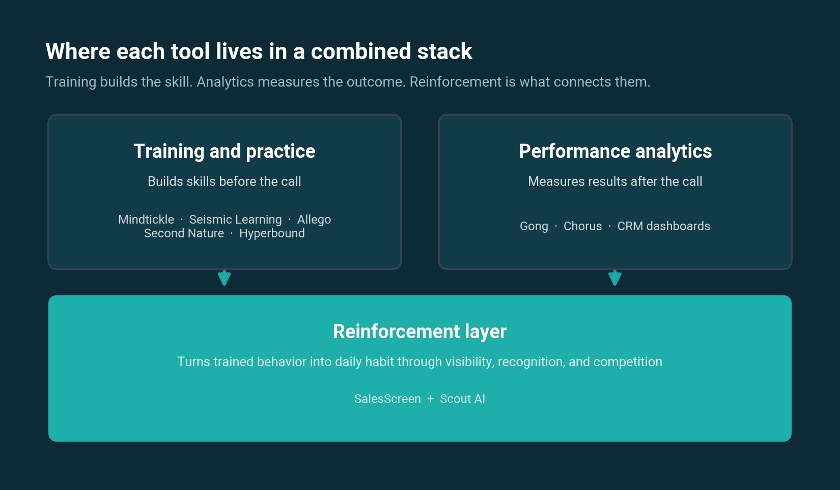
- Most tool categories do one job well: readiness platforms (Mindtickle, Seismic Learning, Allego, SalesHood) build skill, conversation intelligence (Gong, Chorus) measures real calls after the fact, and practice tools (Second Nature, Hyperbound) build confidence in a sandbox. None of them close the loop on their own.
- Start with the behavior you want to change and define its leading indicators before shopping for tools. Buying the reinforcement layer without a clear target behavior just adds another dashboard.
Why training tools and analytics tools underperform on their own
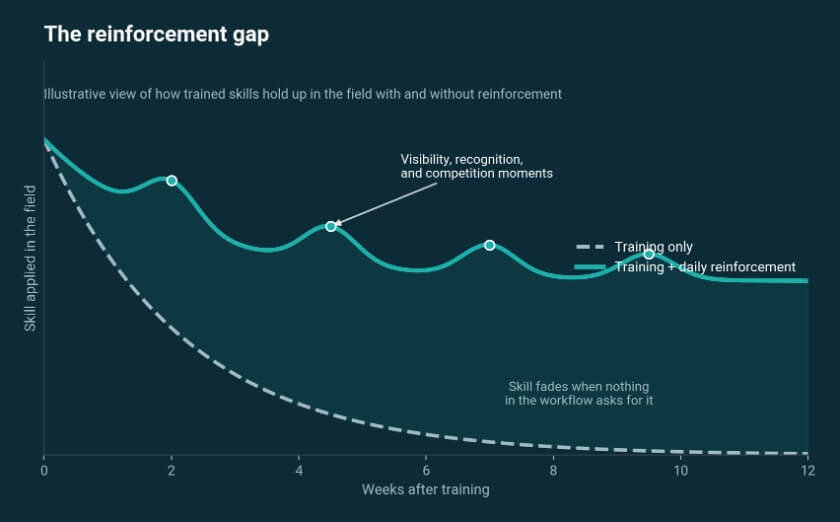
Start with training. The classic failure mode isn’t bad content, it’s decay. A workshop generates energy, reps leave with full notebooks, and within weeks most of that skill has quietly evaporated because nothing in the daily workflow asked for it again. Gartner’s research on sales performance is blunt about this: sellers struggle to find, consume, and apply training in their everyday workflow, and 83% of sales leaders say their sellers struggle to adapt to changing customer needs and expectations. Training that lives outside the flow of work stays outside the results.
Analytics has the opposite problem. Most sales dashboards are built on lagging indicators: revenue closed, quota attainment, win rate. Those numbers are accurate and almost entirely unactionable, because by the time they move, the behavior that produced them is weeks old. A full breakdown of that trap lives in our guide to sales performance metrics, but the short version is this: measurement alone doesn’t change behavior. A rep doesn’t sell differently because a report exists.
And simply adding more tools makes it worse, not better. Salesforce’s latest sales statistics show sellers already use an average of eight tools to close a deal, and 42% of reps feel overwhelmed by the number of tools in front of them. Meanwhile, a 2026 Gartner survey found that even when AI hands sellers back nearly five hours a week, 72% of sales organizations fail to reinvest that time into high-value activities. The constraint isn’t access to training or access to data. It’s the absence of a system that turns both into daily behavior.
What combining training and analytics actually requires
When leaders search for tools that combine training and analytics, what they usually mean is: I want to know whether the training worked, and I want the data to make it keep working. That comes down to three capabilities, and very few single platforms deliver all of them.
The first is shared behavioral data. Training completions in one silo and CRM activity in another tells you nothing about whether trained skills transferred to the field. The systems need to look at the same reps, the same activities, and the same week.
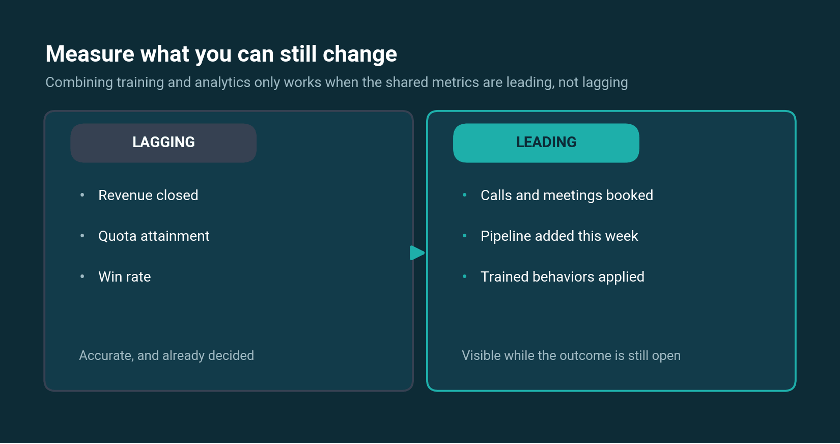
The second is measurement at the level of leading indicators. If your only feedback loop is win rate, you won’t know whether the new discovery framework stuck until a full sales cycle has passed. Activity-level signals, calls, meetings booked, pipeline added, stage progression, tell you within days whether behavior changed. That’s the same logic that powers predictive sales analytics: read the inputs, not just the outcomes.
The third, and the one most stacks are missing entirely, is a reinforcement loop the rep actually sees. Data that sits in a manager’s report changes management. Data a rep sees at 2 pm on a Tuesday changes selling. We’ve covered how real-time sales data drives behavior in depth, but the principle is simple: reinforcement only works when the feedback arrives while the outcome is still open.
The best tools, organized by the job they do
Most tool roundups rank fifteen platforms against each other as if you were choosing one. That’s not how a working stack gets built. Training platforms, conversation intelligence, practice tools, and reinforcement platforms do different jobs, and the honest comparison is within each job, not across them. Here are the strongest options in each layer, and where each layer stops.
Training and readiness platforms
Mindtickle is the strongest option for structured enterprise readiness. Its Readiness Index scores reps across training completion, assessments, and real performance, which makes it one of the few training platforms that even attempts the analytics side of the equation. It suits organizations with formal enablement programs and certification workflows, and its depth can feel heavy for smaller teams.
Seismic Learning, formerly Lessonly, brings lesson building, AI role play, and skill assessments into the wider Seismic enablement ecosystem. It’s a natural pick if content management and training should live under one roof.
Allego unifies learning, content, and coaching with an emphasis on reinforcing skills in the flow of work, and SalesHood pairs AI coaching agents with structured onboarding paths aimed at faster ramp. Both are credible mid-market and enterprise choices.
Where this whole layer stops: these platforms measure learning. Course completion, assessment scores, and certification status tell you a rep absorbed the material. They don’t tell you whether the rep used it on Thursday afternoon with a live prospect.
Conversation intelligence and coaching analytics
Gong captures and analyzes real customer conversations across calls, email, and meetings, then surfaces the patterns that separate won deals from lost ones. For coaching, it’s the closest thing to game film that sales has. Chorus by ZoomInfo covers similar ground with strong post-call analysis and highlight reels of top performer moments, and it fits naturally for teams already inside the ZoomInfo ecosystem.
These tools are genuinely analytics-first, and they close part of the training loop by showing whether trained language and frameworks appear in real conversations. Their limit is timing. The feedback arrives after the call is over, which makes it excellent input for the kind of data-driven coaching conversations managers should be running, and no help at all in changing what the rep does between those conversations.
AI role play and practice tools
Second Nature and Hyperbound both give reps a safe place to rehearse. AI buyer personas simulate discovery calls, objections, and demos, then score the rep on delivery and framework adherence. For onboarding and for the middle of the team, who typically get the least one-on-one coaching time, unlimited practice without a manager in the room is a real advance.
The limit is the same one every simulator has: confidence built in a sandbox still has to survive contact with a real pipeline. Practice tools raise the floor on skill. They don’t create the daily pull that keeps a rep applying that skill when the novelty wears off.
The reinforcement and performance layer
This is the layer the other three categories assume someone else is handling, and usually nobody is. SalesScreen sits directly on top of your CRM activity data and turns the behaviors you trained into things reps see, chase, and get recognized for every day. Leaderboards, competitions, milestone celebrations, and personal progress views make leading indicators visible at the moment they can still change, and visibility isn’t decoration, it’s the mechanism that moves middle performers.
In practice, that connection looks concrete. A multi-location insurance agency that just trained advisors on a new renewal conversation can run a three week competition on renewal calls logged, so the trained behavior has a scoreboard. A mid-market SaaS team replacing manual SPIFFs can point the incentive at discovery questions asked rather than deals closed, which rewards the input the training targeted. Scout AI, SalesScreen’s built-in assistant, watches the same activity data and flags the coaching moments a busy manager would otherwise catch three weeks late.
SalesScreen doesn’t replace your training platform or your conversation intelligence. It’s the layer that makes both pay off, because it closes the loop your sales performance management system needs between insight and daily action. Training tells reps what to do. Analytics tells leaders what happened. Reinforcement is what makes the two agree.
How to build the combined stack without buying everything
You don’t need five new contracts. Start with the behavior, not the tool. Pick the one or two selling behaviors your last training program was supposed to change, then define two or three leading indicators that prove those behaviors are happening. If you can’t name the indicator, the training was a hope, not a program.
Next, make those indicators visible where reps already work, and recognize progress on them rather than only celebrating closed deals. A rep who improved their discovery this week should feel seen. Then give managers one shared view of training status and live activity, so coaching conversations run on evidence, not memory. If you want the full operating model behind this, our guide to building a sales enablement strategy that changes behavior walks through it step by step.
Only after that should you shop. Buy the training platform that fits your motion, keep conversation intelligence if call coaching is your bottleneck, and add a reinforcement layer over the top so neither investment fades by week five.
Close the loop, not just the deal
Training and analytics are both solved problems. The market is full of excellent platforms that teach and excellent platforms that measure. What most sales organizations are still missing is the layer in between: a system that makes trained behavior visible, recognized, and worth repeating every single day.
That’s the layer SalesScreen was built for. If your team completed the training and the dashboard still isn’t moving, book a demo and see what happens when your performance data starts working for your reps instead of just reporting on them.
Frequently asked questions
What is the difference between a sales training platform and a sales enablement platform?
A sales training platform focuses on skill development: courses, certifications, assessments, and role play. A sales enablement platform typically adds content management, buyer engagement tools, and analytics on top of training. Platforms like Mindtickle, Seismic, and Highspot increasingly blur the line by offering both in one suite.
Can one tool handle both sales training and performance analytics?
Partially. Readiness platforms like Mindtickle score reps on a blend of learning and performance data, and conversation intelligence tools like Gong analyze real selling behavior. But no training platform makes performance data part of a rep’s daily motivation, and no analytics platform teaches skills. Most teams get the full loop by pairing one tool per layer with a reinforcement platform that connects them.
What metrics show whether sales training is actually working?
Look at leading indicators tied to the trained behavior within two to four weeks: activity volume, discovery questions asked, meetings booked, stage conversion on the step the training targeted, and ramp time for new hires. Lagging metrics like win rate and quota attainment confirm the impact later, but if the leading indicators haven’t moved within a month, the skill isn’t being applied.
How does gamification connect training to performance data?
Gamification turns performance data into a live feedback loop. When a trained behavior becomes a visible metric on a leaderboard or the basis of a competition, reps get daily evidence that the new skill matters, and recognition when they apply it. That repeated visibility is what moves knowledge from a completed course into a durable habit.
What should a team of 20 to 100 reps buy first?
Start with whichever layer addresses your sharpest pain. If new hires ramp slowly, a training or practice platform comes first. If deals stall in conversations, conversation intelligence earns its keep fastest. If reps know what to do but don’t do it consistently, which is the most common gap at this size, a reinforcement platform on top of your existing CRM delivers the quickest visible change.
How is AI changing the combination of training and analytics?
AI now works on both sides of the gap. Role-play simulators generate unlimited practice, and conversation intelligence scores every call instead of the handful a manager can review. On the performance side, assistants like Scout AI read live activity data and surface which rep needs a coaching conversation this week, so the insight arrives while there’s still time to act.
