

A sales performance evaluation is only as useful as it is fair. Here’s what separates a review reps trust from one they dread, and how to run it.
Sales performance evaluations have a reputation problem. For a lot of managers, they feel like a quarterly box to tick. For a lot of reps, they feel like a verdict handed down by someone who hasn’t been on a call in years.
Across the sales teams we work with, the reviews that go wrong are rarely about the best or worst reps. They go wrong in the middle, where managers have the least clean data and lean hardest on gut feel. A fair evaluation fixes that by grounding the conversation in what both sides can actually see.
This guide breaks down what a fair sales performance evaluation looks like, the metrics and frameworks that keep it honest, and how to run reviews your team will trust.
Key Takeaways
- A fair sales performance evaluation is consistent, transparent, and grounded in visible data rather than gut feel, which is what turns a review from a verdict into a shared read on the same numbers.
- Match the metric to the role. An SDR, an account executive, and an account manager should each be measured against KPIs that fit their actual job, and newer reps against ramp-focused targets.
- Blend quantitative metrics like quota attainment and win rate with qualitative signals like communication and CRM hygiene, since the numbers tell you what happened and the behaviors tell you why.
- Recognize progress, not just position. The middle 60 percent of your team holds the biggest upside, and a fair review gives them the same clear path forward that top performers get.
- AI makes fair evaluation easier to reach by reading a rep’s full history, surfacing the overlooked middle, and flagging unrecognized effort, while the manager still owns the coaching conversation.
What is a sales performance evaluation?
A sales performance evaluation is a structured review of a rep’s results, behaviors, and growth areas, measured against clear goals. A fair evaluation pairs quantitative metrics like quota attainment, win rate, and pipeline coverage with qualitative signals like communication, CRM hygiene, and team contribution. The goal isn’t to grade reps. It’s to give every person on the team the same clear path to improve.
Done well, evaluations happen on a regular rhythm rather than once a year. Monthly check-ins and quarterly reviews let managers catch a slipping close rate early, find the cause, and adjust before it becomes a quarter-ending problem. It helps to treat each evaluation as one moment in a continuous sales performance management practice rather than a standalone event.
Why fair sales performance evaluations matter
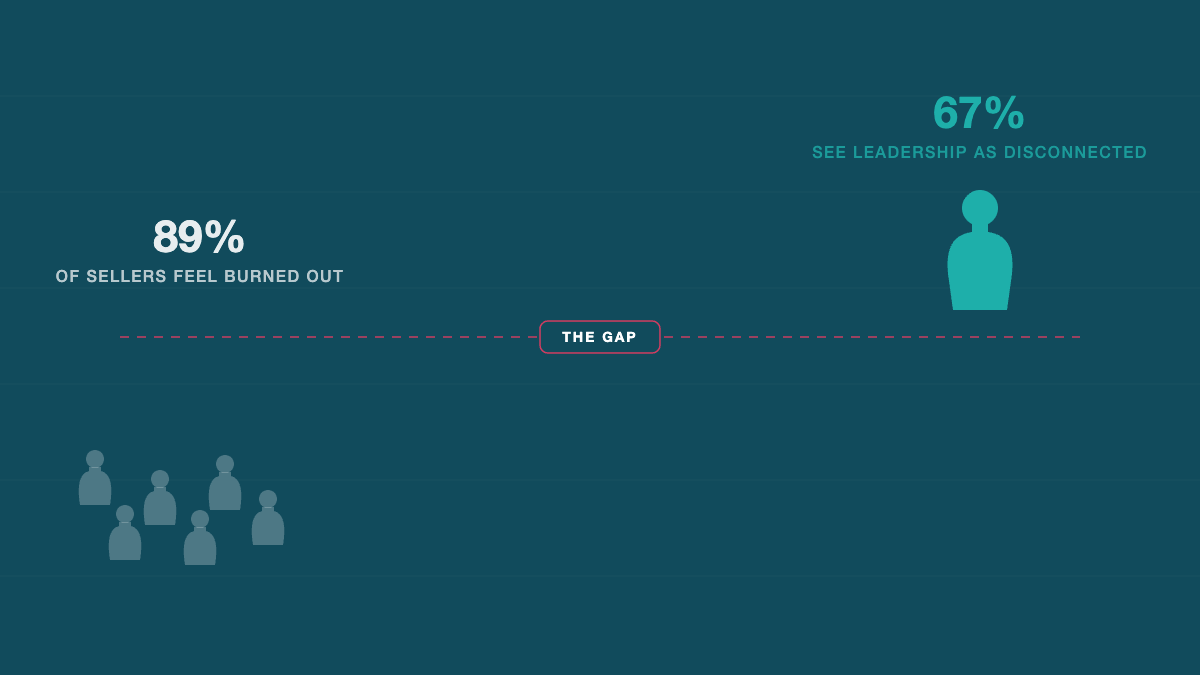
Sales is hard right now, and reps feel it. In a 2022 Gartner survey of more than 900 B2B sellers, 89 percent reported feeling burned out and 54 percent said they were actively looking for another job. The same research found that 67 percent of sellers believe their leadership is overly optimistic and disconnected from the daily reality of selling.
That gap is exactly what a fair evaluation closes. When a review is built on data a rep can see and verify, it stops feeling like a judgment from above and starts feeling like a shared read on the same numbers. That shift matters for retention too. Gallup and Workhuman research that tracked nearly 3,500 employees found that those who received high-quality recognition were 45 percent less likely to have left their organization two years later. The way you frame and acknowledge performance has a direct line to who stays.
There’s a revenue case as well. McKinsey’s analysis of nearly 500 B2B companies found that top-quartile sales organizations generate roughly two and a half times more gross margin per sales dollar than the bottom quartile and that the gap between leaders and the rest is widening. Helping your middle and developing performers operate more like your best ones is one of the most reliable ways to grow revenue, and a fair evaluation is where that work starts.
What makes a sales performance evaluation fair?
Fairness isn’t about being soft. It’s about being consistent, transparent, and grounded in evidence rather than impression. Five principles tend to separate a review rep's respect from one they resent, and they usually stand or fall together.
A fair review applies the same standards to everyone, so reps in the same role are measured against the same KPIs and the same definition of good. It runs on visible data rather than memory, which means the manager and the rep are looking at the same dashboard, and the conversation starts from facts instead of competing recollections. It matches the metric to the role, because an SDR and an account manager no more share a scorecard than they share a job. It separates effort from outcome, so a quarter built on an inherited pipeline and one built from scratch never look identical on paper. And it recognizes progress rather than position alone, giving a rep climbing out of the bottom third visible credit before they reach the top.
When all five hold, reps stop arguing about whether the review is fair and start talking about how to get better. That’s the whole point.
The metrics that keep evaluations honest
Numbers are what make an evaluation defensible. Lean only on one or two, though, and you get a distorted picture that punishes the wrong people. A fair review blends quantitative sales performance metrics with qualitative ones.
The quantitative side keeps the review objective. The qualitative side explains why the numbers look the way they do, which is where coaching actually happens. A rep with strong activity and a weak close rate has a very different problem from a rep with low activity and a high close rate, and only the full picture tells you which is which.
Match the metric to the role
One of the fastest ways to make an evaluation feel unfair is to judge every rep by the same yardstick. Different roles drive different outcomes, so their KPIs should differ too.
For newer reps, swap in ramp-focused KPIs tied to a 30, 60, and 90 day plan. Holding a rep in week six to the same number as a rep in year three is the kind of mismatch that quietly erodes trust.
The same principle applies across verticals. An insurance advisor covering a mature renewal book and one building new business from scratch shouldn’t be weighed on the same win-rate target. A bank measuring branch cross-sell rates cares about different behaviors than a mid-market SaaS team scoring SDRs on meetings booked. The KPIs shift with the motion. The fairness principle doesn’t.

Watch leading indicators, not just lagging ones
Revenue is a lagging indicator. By the time it dips, the cause is already weeks old. Leading indicators like prospecting volume, follow-up rate, and proposal turnaround predict where results are heading, which means you can step in before a shortfall shows up in the numbers.
A drop in new meetings booked this month tends to surface as fewer closed deals next quarter. Reading both together lets you coach early and gives reps a fair warning rather than a surprise at review time. It’s also one of the most reliable ways to improve sales performance across the whole team rather than just the top of it.
Frameworks that build fairness in
Structure is what keeps personal bias out of the room. A few proven frameworks do most of the heavy lifting.
- A balanced scorecard measures performance across financial results, internal process, customer feedback, and learning and growth, so no single number dominates.
- Behaviorally anchored rating scales, or BARS, tie each score to a specific, observable behavior instead of a vague label like “meets expectations,” which makes feedback far more precise.
- 360-degree feedback gathers input from managers, peers, and sometimes customers, surfacing strengths a single manager might miss, like a rep who quietly mentors the SDR team.
- Self and peer evaluation lets reps reflect on their own quarter and learn from teammates in the trenches, which builds ownership rather than defensiveness.
Most teams combine two or three of these. A balanced scorecard for the numbers, BARS for the behaviors, and a quick self-evaluation to start the conversation is a strong, fair default.
How to run a fair sales performance evaluation, step by step
Here’s a repeatable process that keeps reviews consistent across your team and across quarters.
Set clear, role-specific goals
Document them as SMART targets so every rep knows the exact number they’re working toward. Keep stretch goals realistic. A 10 percent climb motivates; a 50 percent jump in one quarter usually backfires. Where a quota feels daunting, breaking it into smaller daily goals keeps reps focused on actions they can control.
Pull the data before the meeting
Gather metrics from your CRM and dashboards, and layer in customer feedback for context. Ground the conversation in facts so it never turns into one person’s word against another’s. Making performance visible through data visualization and rep accountability also means the rep has already seen the same numbers before they walk in, and AI can speed the prep by summarizing each rep’s quarter and flagging the patterns worth talking through.
Run the review as a two-way conversation
Open with what went well, move into growth areas with specific examples, and ask the rep what felt hard this quarter. Reps who help diagnose their own gaps are far more likely to close them.
Build a concrete improvement plan
Pair every growth area with an action, a resource, and a deadline. Three weeks of objection-handling role plays with a top performer, built from proven sales coaching techniques, beats a vague note to “improve closing.”
Check whether the strategy itself needs work
Not every dip is the rep’s fault. If the same objection keeps surfacing or leads keep drying up, the issue may be messaging, targeting, or territory, not the person.
Common fairness mistakes to avoid
Even well-meaning managers slip into patterns that quietly undermine trust, and most of them trace back to the same habit of leaning on impression instead of the full record. Recency bias is the most common, weighting the last two weeks more heavily than the full quarter, and a rolling view of the data is usually enough to correct it. More costly is the habit of ignoring the middle. Top performers get praise and strugglers get coaching, while the 60 percent in between get neither, even though that group is consistently where a small lift moves the team number the most.
Two others show up almost as often. Comparing reps across different conditions treats two people closing the same revenue as equal when one inherited half their pipeline, and the other built it from scratch. And reviewing without recognition leaves reps deflated, because a review that only lists gaps gives them nothing to act on, where naming specific wins keeps the conversation balanced and worth having.
Where does AI make sales performance evaluations fairer?
AI makes evaluations fairer by holding the full picture a single manager can’t. Two of the most common fairness mistakes, recency bias and overlooking the middle, share one root cause. There’s more performance data than any manager can keep in their head, so reviews drift back toward memory and gut feel, which is exactly where bias creeps in.
What AI handles well
Pointed at clean performance data, AI is good at the specific work that creates those two mistakes:
- It reads the whole quarter, not just the last two weeks, so recency bias has nowhere to hide.
- It scans the entire team at once, which surfaces the steady middle performers who usually get skipped.
- It spots unrecognized effort, like a rep with high activity who hasn’t earned an achievement yet.
- It flags a slipping metric early, while there’s still time to coach rather than just report.
The upside is measurable, not theoretical. Gartner found that sellers who effectively partner with AI tools are 3.7 times more likely to meet quota than those who don’t, which suggests the same pattern reading that makes a review fairer also makes a team more productive.
What stays with the manager
None of this replaces your judgment. It makes sure that judgment is working from the full picture rather than the last conversation you happen to remember. That’s the idea behind Scout AI, the guide built into SalesScreen. It reads your live performance data and turns a direct question into a direct answer, so asking who’s putting in the work but hasn’t been recognized yet surfaces an overlooked middle performer instead of a hunch. The pattern reading is the machine’s job. The coaching conversation stays yours.
The takeaway
A fair sales performance evaluation isn’t about being lenient. It’s about being consistent, transparent, and honest with the data. Match the metric to the role, blend hard numbers with the behaviors behind them, recognize progress as well as position, and keep the underlying information visible all the time rather than once a quarter.
Get that right and reviews stop being something your team dreads. They become the moment every rep gets a clear, trusted answer to the question that actually matters. Where do I stand, and how do I get better?
Want to see what your reps see when performance is visible in real time? Take a look at how SalesScreen keeps evaluations grounded in real-time performance data.
Frequently asked questions
How often should you evaluate sales performance?
Track key metrics continuously, review them informally each month, and run a formal evaluation each quarter. That rhythm gives reps timely feedback and lets managers correct course before small issues compound.
What’s the fairest way to evaluate a sales rep?
Measure every rep in the same role against the same role-specific KPIs, base the conversation on data both of you can see, and pair every quantitative number with the qualitative context behind it. Transparency is what makes it fair.
Should compensation be tied to performance evaluations?
Yes, as long as the criteria are clear and measurable in advance. Tying rewards to defined KPIs builds accountability and trust. Tying them to subjective impressions does the opposite.
How do you evaluate new sales reps fairly?
Use ramp-focused KPIs tied to a 30, 60, and 90-day plan rather than a full quota. This tracks skill and activity growth and gives new hires credit for progress while they build toward steady-state targets.
What should you do if your team resists evaluations?
Frame the review as a growth tool rather than a verdict. When reps can see the data themselves and the conversation centers on how to improve, resistance tends to fade because the process feels fair.
Which KPIs matter most in quarterly sales evaluations?
Quota attainment is the headline, since it measures each rep against the target they own. Around it, managers weigh win rate, average deal size, sales cycle length, and pipeline coverage. The mix shifts by role, and the best managers pair these lagging numbers with leading indicators like activity and follow-up rate, so the review explains why results landed where they did rather than just recording them.
What are the best practices for evaluating sales data and giving feedback?
Start with the full data set rather than recent memory, and judge each rep against role-specific benchmarks and their own trend line. Pair every number with the context behind it, so a low close rate gets traced to its real cause. Then open with a specific win, tie each gap to an example, and turn it into a plan with an action, a resource, and a deadline.
