

Scaling a sales team isn’t just a hiring problem. It’s a question of whether visibility, coaching, and recognition can keep pace with headcount, or whether growth quietly erodes the performance it was meant to create. This guide covers what actually breaks when sales teams scale fast, and how to build the reinforcement layer that lets growth hold.
Every VP of Sales has sat in this meeting. The board wants forty more reps this year. The CRO wants revenue up sixty percent. Headcount gets treated as the lever that solves both problems at once, so the team hires: six new AEs this quarter, four more the next, a couple of SDRs to keep the pipeline fed.
Three months later, the number still isn’t moving the way that much headcount growth should move it.
The instinct is to blame the hires. That’s rarely where the problem sits. What actually breaks when a sales team scales fast is the reinforcement layer underneath it, the visibility, coaching, and recognition that made a ten-person team perform well in the first place. Scaling a sales team faster doesn’t start with hiring faster. It starts with making sure that layer scales at the same pace headcount does, so growth doesn’t quietly cost the performance it was supposed to buy.
Key takeaways
- What breaks when a sales team scales fast usually isn’t the hires. It’s the reinforcement layer, visibility, coaching, and recognition that made the team perform well at a smaller size.
- Manager span of control climbed to 12.1 direct reports on average in 2025, up nearly 50% since 2013. Bigger teams can still perform well, but only when the manager has bandwidth left after individual contributor work.
- Five levers matter most: build the hiring engine before pulling the trigger, add management layers before the team outgrows them, ramp new hires without draining top performers, keep reinforcement systems ahead of headcount, and watch for the three failure patterns that show up mid-scale.
- Culture dilutes first, top performers absorb too much informal load next, and forecasting accuracy slips last, even though it’s usually the first thing leadership notices.
- None of the three failure patterns are hiring problems. They’re reinforcement problems that hiring simply exposes faster.
Why scaling a sales team breaks long before headcount does
Team growth is the default plan for most sales organizations right now. HubSpot found that nearly half of sales leaders expect their teams to expand this year, and only a small share expect them to shrink. That means most VPs of Sales reading this are already mid-scale or about to be.
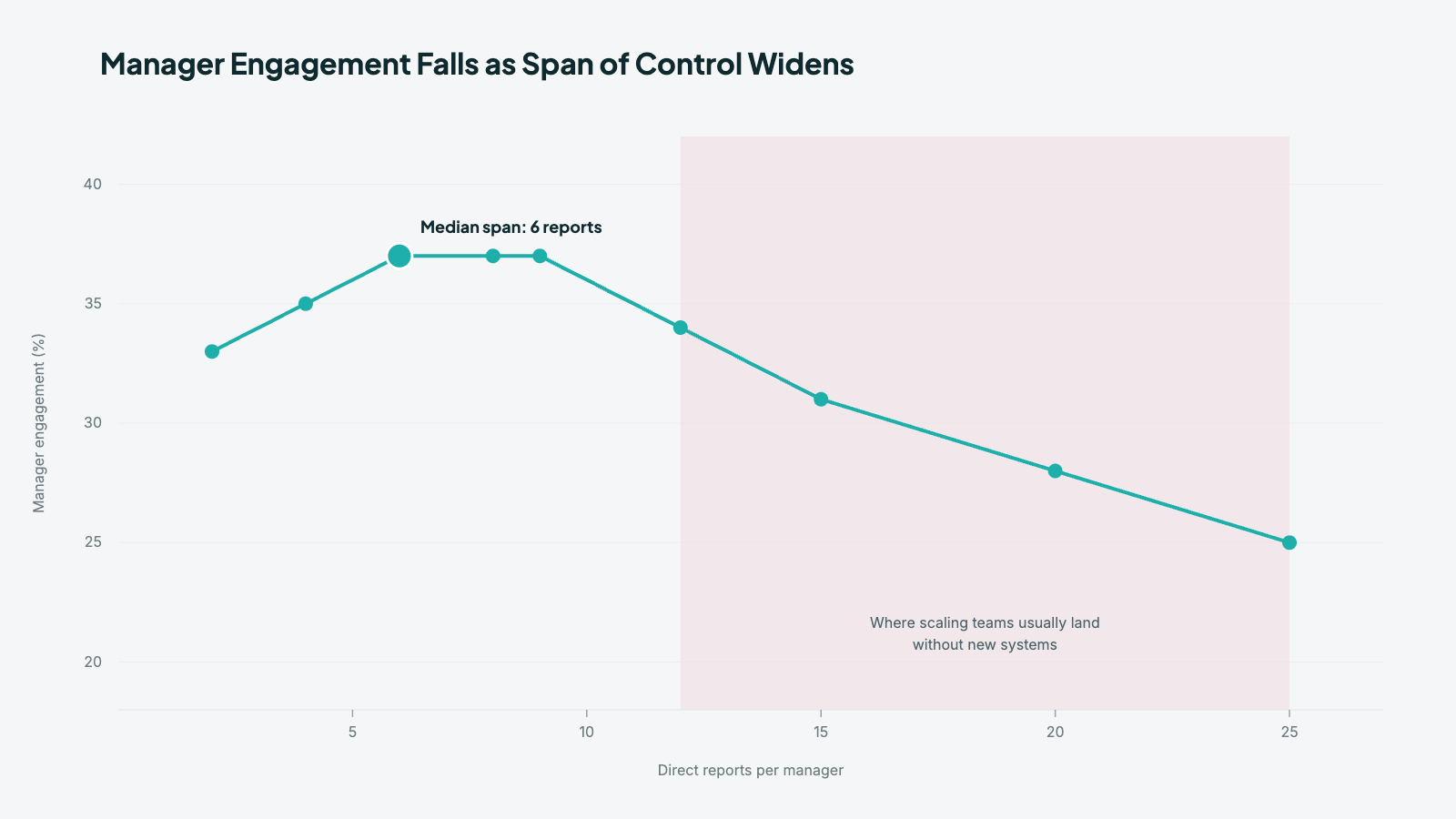
What rarely gets discussed is what growth does to the manager layer. Gallup’s most recent research on span of control found that the average number of people reporting to a single manager climbed to 12.1 in 2025, up nearly fifty percent since Gallup first measured the figure in 2013. The median manager still leads about six people, but a growing share of teams stretch well past that, often because a scaling push adds headcount faster than it adds managers.
Gallup’s research is careful not to say bigger teams are automatically worse. Highly engaged teams of twelve or more can outperform poorly managed teams half their size. What determines the outcome is whether the manager has the tools and time to lead at that scale, not the raw number on the org chart. Managers who spend less than forty percent of their time on individual contributor work sustain meaningfully higher engagement as their teams grow, while managers buried in day-to-day selling see engagement drop the moment their span widens.
That’s the mechanism behind most stalled scaling pushes. A manager who could run tight one-on-ones and catch a slipping rep early with six direct reports can’t do the same thing informally with fourteen. The coaching doesn’t disappear because anyone stopped caring. It disappears because the system it ran on, a manager’s personal attention, was never built to scale. This is the piece a sales performance management framework is meant to solve: replacing manager memory with structure that keeps visibility, coaching, and recognition consistent no matter how many reports a manager carries.
Five steps to scale a sales team faster for sustainable growth
1. Build the hiring engine before you pull the trigger
Scaling faster still starts with hiring, just not in the way most headcount plans assume. McKinsey’s recent research on B2B sales growth found that companies outgrowing the market invest in sales operations infrastructure at 1.4 times the rate of slower-growing peers. Teams that hire the reps first and figure out the operating rhythm later tend to spend that advantage paying down debt instead of compounding it.
That debt shows up in a specific place. The same research points to sales operations teams now spending seventy-three percent of their time on non-sales administrative work, up from thirty-nine percent in 2019, largely because reporting and forecasting haven’t scaled alongside headcount. Every hour a manager spends assembling a spreadsheet is an hour not spent coaching a new rep through their first pipeline review.
The practical fix is to size the hiring plan against pipeline capacity, not against a revenue target alone. A mid-market SaaS team running twenty SDRs and thirty AEs typically knows its meetings-to-pipeline and pipeline-to-close ratios well enough to model how many new reps the funnel can absorb without diluting lead quality per rep. Predictive sales analytics built on activity data, not just deal-stage data, gives leaders an early read on whether the funnel is genuinely ready for the next wave of hires or whether adding headcount now just spreads the same lead volume thinner.
2. Add management layers before the team outgrows them
If the median manager leads about six people, the math on when to add a first-line manager isn’t complicated. It gets complicated when leaders wait for a manager to visibly struggle before promoting one, which by definition means the team has already been under-managed for months.
A useful gut check before adding a manager: Is the current lead spending more than forty percent of the week on individual contributor work? Do reps go more than a week without a real coaching conversation? Would a new hire joining next month get a structured ramp plan, or a figure-it-out-later plan? If the honest answer to any of those points toward strain, the team has already outgrown its management layer, even if the org chart hasn’t caught up.
Adding a manager solves the org chart problem. It doesn’t automatically solve the visibility problem, because a new manager inherits the same blind spots the team already had: no consistent view of who’s trending toward a missed number until the quarter confirms it. Dashboards built for decisions, not just reporting, matter more during a scaling push than at any other point in a team’s life. A new manager who inherits a view that surfaces leading indicators can start coaching in week two. One who inherits a dashboard built for quarterly reviews spends the first two months learning the team the slow way.
3. Ramp new hires without draining your best reps
Every fast-growing team hits the same tradeoff eventually: someone has to ramp the new hires, and the people best positioned to do it are the top performers whose time is also the most expensive to pull off the floor. Pairing every new SDR with a senior AE for shadow calls sounds reasonable until the fifth new hire starts and the senior reps are spending more hours mentoring than selling.
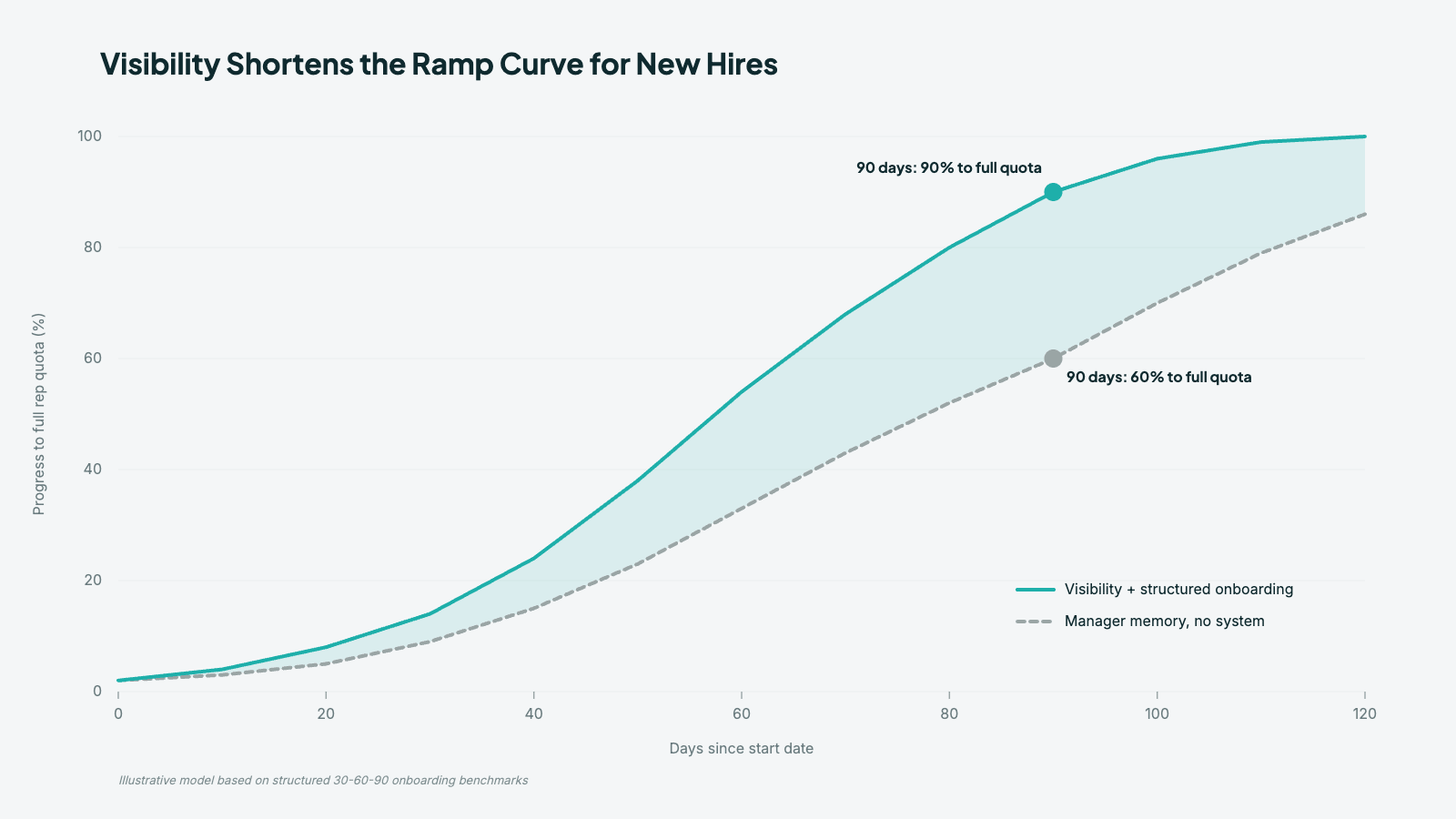
Structure absorbs some of that pressure. Teams running a defined thirty-sixty-ninety plan, with a sales enablement strategy that ties training to measurable behavior change, consistently ramp faster than teams handing new hires a slide deck and a login. But structure alone still depends on a mentor’s calendar. What changes the equation is giving new hires a way to see their own progress without waiting on a manager or a peer to tell them, which is exactly what real-time performance data does for a ramping rep: a daily view of activity against a milestone, rather than a monthly check-in that arrives after the gap has already widened.
AI is starting to absorb some of the manual coaching load too. Salesforce’s most recent State of Sales research found that more than half of sellers have already used AI agents in their workflow, and sales leaders using them point to faster rep onboarding as one of the clearest early wins, alongside faster deal research and outreach personalization. None of that replaces a manager’s judgment. It does mean fewer hours of manual repetition standing between a new hire and full quota.
4. Keep reinforcement systems ahead of headcount, not behind it
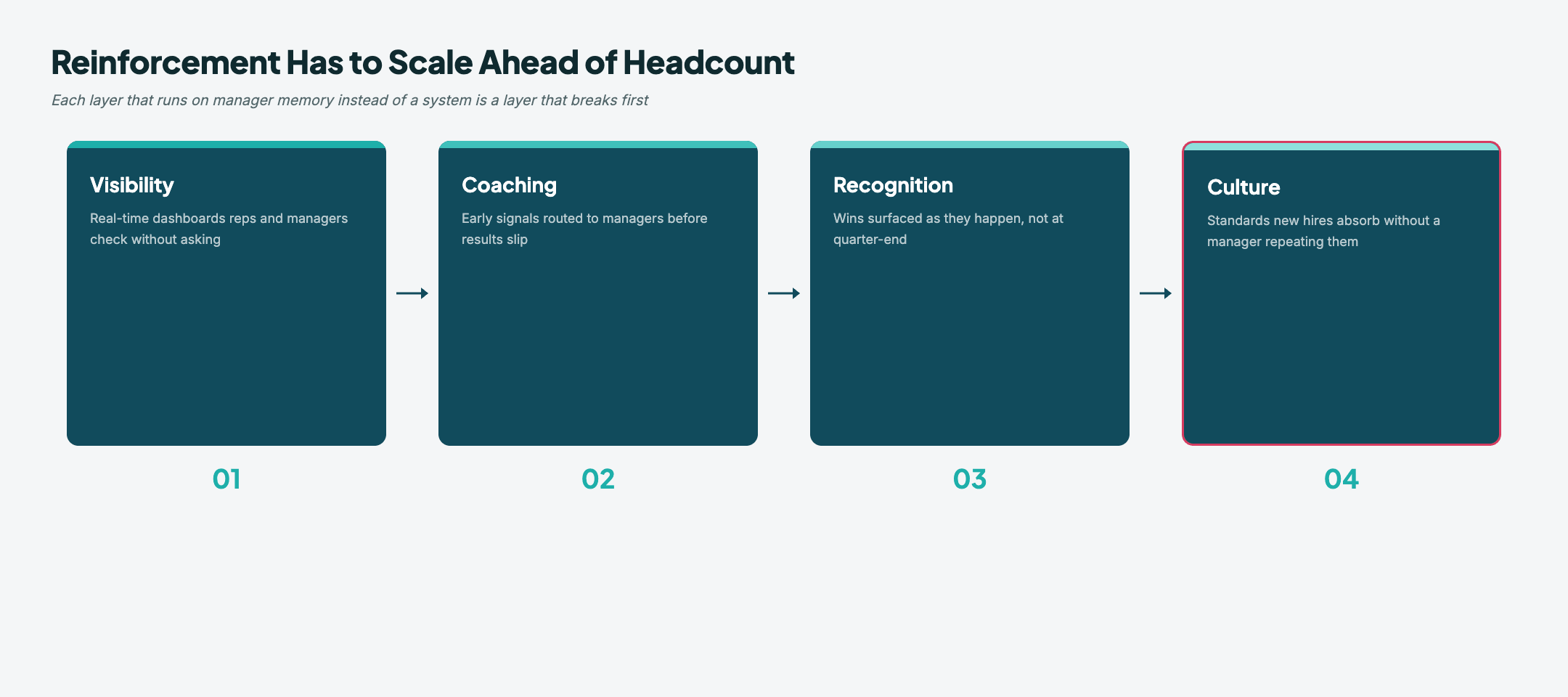
Teams that scale well treat recognition and motivation as infrastructure, not as an extra layered on once the org chart stabilizes. That ordering matters. A gamification system that already runs on live CRM activity absorbs twenty new reps without anyone needing to manually track twenty new leaderboards. A recognition process that lives in a manager’s head, a mental note to shout someone out in the next team meeting, doesn’t.
This matters most for the middle of the distribution, which is also where scaling teams add the most headcount. New hires start in the middle by definition. If motivating a sales team depends on a manager noticing individual effort in real time, that noticing gets harder every time the team doubles, precisely when new reps most need to see that their early activity is visible and valued.
The fix isn’t more manager attention. It’s building systems that don’t require it: automated milestone recognition, activity visibility reps can check without asking, and coaching prompts, the kind Scout AI surfaces from live activity data, that flag a slipping rep before a one-on-one would have caught it. A regional bank scaling its advisory pods from four managers to nine doesn’t need each new pod lead to invent a recognition cadence from scratch if the visibility and reward layer already runs consistently across the organization. The manager still delivers the message. The system makes sure there’s a message to deliver.
Culture dilutes first. A ten-person team absorbs its norms by osmosis. A forty-person team needs those norms written down and reinforced on purpose, or new hires build their own version of “how we do things here” from whoever happens to sit near them.
Top performers carry too much of the load next. Every scaling team leans on its best reps to mentor, demo, and set the pace, and every scaling team risks burning some of them out doing it if that load isn’t distributed or supported by structure.
Forecasting accuracy slips last, and it’s often the first thing leadership notices even though it’s the last domino to fall. A team with more reps but the same visibility infrastructure has more noise feeding the forecast, not more signal. AI-assisted sales pipeline management that scores deal health continuously catches this earlier than a manager reviewing forty opportunities by hand ever could.
None of these three are hiring problems. They’re reinforcement problems that hiring simply exposes faster. All three respond to the same fix: build the visibility, coaching, and recognition systems to run ahead of headcount instead of catching up to it after growth has already outpaced them.
Build the systems that let growth hold
Scaling a sales team faster was never really about hiring velocity. It’s about whether the systems underneath the org chart, the visibility that lets a rep see their own pace, the coaching that catches a slip before it becomes a missed quarter, the recognition that reaches every new hire and not just the loudest performer, can carry the weight of a bigger team without a manager holding it all together by memory.
Get that layer right, and headcount growth compounds instead of diluting. See how SalesScreen helps scaling sales teams keep visibility, coaching, and recognition consistent as headcount grows, one rep, one milestone, one team at a time.
Frequently asked questions
What’s the ideal manager-to-rep ratio when scaling a sales team?
There’s no single ideal number. Gallup’s research puts the median at around six direct reports per manager, with engagement holding steady up to eight or nine when managers have the talent and time to coach. Beyond that, the ratio matters less than whether the manager still has bandwidth left after their own individual contributor work.
How fast can a sales team scale without losing performance?
It depends less on hiring pace than on whether visibility, coaching, and recognition scale alongside headcount. Teams that build managers, dashboards, and structured onboarding ahead of growth can absorb faster hiring than teams that add reps first and build systems later.
Should sales operations be built before or during a scaling push?
Before, wherever possible. McKinsey’s research on B2B sales growth found that companies outgrowing the market invest in sales operations infrastructure at 1.4 times the rate of slower-growing peers. Waiting until headcount strain forces the investment usually means spending the first months of a scaling push catching up instead of compounding.
How long does it take a new sales hire to ramp on a fast-growing team?
Ramp time varies by role and sales cycle length, but structure is the biggest lever leaders control. New hires with a defined onboarding plan and real-time visibility into their own progress consistently reach productivity faster than reps piecing the role together from a mentor’s spare time.
What’s the biggest reason sales team scaling initiatives underperform?
Most underperformance traces back to reinforcement systems that didn’t scale with headcount, not to the quality of the hires. Culture dilutes, top performers absorb too much informal mentoring, and forecasting accuracy slips because visibility infrastructure stayed built for a smaller team.
Does adding more managers always improve performance during a scaling push?
Not automatically. Gallup’s research found that manager talent and how managers spend their time matter more than headcount on the org chart. A new manager who inherits the same weak visibility tools the team already had will struggle at any span of control.
